Tuesday, 10 December 2013

Editing

Another one of my personal developments is too understand and learn editing more than I already know. Therefore I started to experiment with different images I have stored on my computer that need editing but have always struggled with doing so. An image I have had for a while was this one:


I fell across this image whilst walking back too Oxford Road train station, there were foreign protesters, protesting against war and rape in Iraq. Although being pleased with this overall photo, I wanted to test myself and try too edit out the boy behind the flag. I am a strong believer of not editing photographs too much, the most I do is change the tones and lighting slightly. However, I thought it best too learn more about photoshop for future reference.

Sadly I didn't print screen my steps, therefore I will try and take you through it step by step, the best I can. The main tool I used is the clone tool, it allows you too select the object next too it and clone it exactly the same, which keep the colouring correct. When you select the tool, hold 'alt' and then select the target, (the brick next too it) and then paint it over the subject piece by piece until your happy that the colouring and brickwork look okay. Then, use the burn tool to add more depth to the colouring to make the lighter patches darker, so it stays nice and contrasted. In this case the brickwork just looks dusty, if it were a colour photo it wouldn't have been as easy. This took my a while to figure out and I used some advice off friends who know the programme better.


 Here is the final edited image, granted it isn't the most spectacular editing skills, but it turned out better than expected considering I struggle with Photoshop:


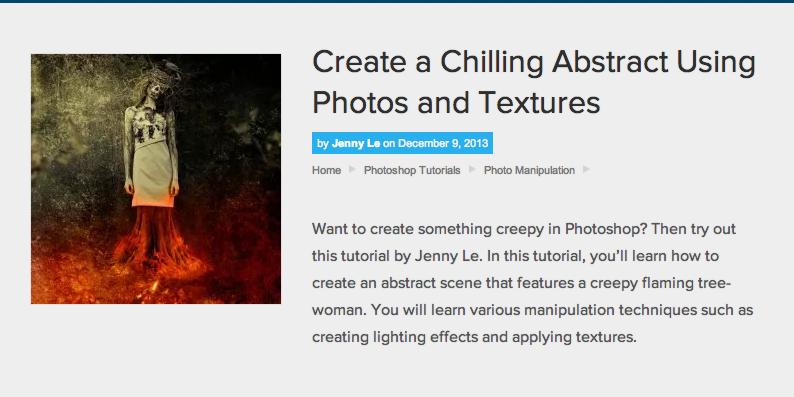
I have been researching into various photoshop classes and tutorials you can pick up from the internet. From researching I came across a website called 'Photoshop Tutorials'. It has many different links too chose from depending on what kind of level of editing skills you are at the current time, they vary from "basics" too "photo manipulation". For an example, I chose the 'Photo Manipulation' which takes you through step by step on how to create a 'chilling abstract'.


As you can see from the image below, it explains well the direct steps too create such a photograph, its a very useful and appears too be free too use to the general public: 


http://www.photoshoptutorials.ws/ 


There are also various different videos on youtube that show you how to use different effects properly and effectively.


I find this kind of method of learning a lot easier than a written step by step, it allows for you to pause and follow the video so you can edit whilst watching. Here is an example of one of the videos:


Sunday, 8 December 2013

Contacting Companies

One of my personal developments was to contact different companies which produce work or have work in the same line of subject matter I am interested in. I had the opportunity to speak to Moira about this subject and she gave me some ideas of who I should be contacting, for example, she mentioned the Army, Charities, newspapers and television channels such as Discovery. The profession I want to get into is War photography, hence the before contacts.

Army 

My main choice too contact would be the Army, therefore I started to research into whether or not they take on photographers from outside the Army. I researched into the Army website too find this -


This is giving a chance for the public too witness what the Army is like from the soldiers point of view

- "Opening the display at the National Army Museum was Dan Snow, broadcaster and Honorary Colonel of the Army’s Media Operations Group.
He said: “These professional and amateur pictures capture elements of Army life that we just don’t see otherwise, and it’s a reminder that excellence on operations is not only about the frontline, but also about the individual, the bond between soldiers, the training and hard work, and also the lighter side of life. It’s great that the Army this year are able to put these images on display for the public for the first time." 
Whether or not photographers can contact the Army and work with them is too be seen, the photograph's on the Army website however appear too be from the soldiers themselves. Perhaps I need to take another route into contacting too gain what I need. 

Newspapers  
Newspaper journalists and photographers seem too be the most efficient way of getting a job as a "War Photographer". Many of the major newspaper companies cover war stricken areas such as Iraq and recently in Syria. Contacting one of these big companies could be the start I need too photographing war zones. One of the many ways photographers become recognised from newspapers are from being a freelance photographer. 


Professional photographers enter countries in war and photograph the events that unfold, then sell there work too newspapers. This is a route I have been contemplating for a long time now, whether I could do it off my own back is yet too be seen. From selling work too newspapers, the newspapers then may give you the opportunity too work for them full-time. This is what I am aiming for with my career. 


Entering Competitions

One of my personal developments is entering more competitions. I want too enter more competitions for a variety of different reasons, the main attraction to them though is for recognition, something that every photographer needs to grasp. Therefore I have been searching for different competitions I could take part in for my personal development assignment and for myself.

One of the competitions I have decided to take part in is the National Geographic Travellers Photography Competition 2014. I decided to enter a photograph under the ''natural'' category, the photograph I chose was one I have adored since taking it last christmas in Tatton Park.


This is the first time I have ever entered a photograph to a competition before, It is exciting to be given the opportunity to submit work at an amateur level, competing against professional's and fellow amateurs. It is also nice to see everyone else's work and what they class "natural" as. 


My Stock Photography

For the project we were asked to photograph our personal development in stock photography format. I kept the images as simple as possible, just with the basic meaning of the image showing. I have never had the opportunity to do stock photography before, it was an eye opener of what is classed as stock imagery.


Enter more competitions


Editing different work using Photoshop/Premiere Pro 


Contact a range of companies in the line of work i'm interested in (War Photography) 


All of these personal developments are things I can do from my own home and are things that I must keep up to date on too succeed in them. The only development which may be a struggle to learn properly on my own is the Photoshop elements and Premiere Pro, these are things I may need to get extra lesson's in or use online tutorials. 
Stock photography is something I am not particularly interested in, but I can see how it helps people explain the basic's through a photograph. We were given various websites to visit in relation too stock photography, one being Alamy. I have also researched others in a previous post. 

Photo Competitions

Fresh Faced + Wild Eyed - http://ffwe2013.thephotographersgallery.org.uk/

One of our first sessions involved a presentation on Fresh Faced and Wild Eyed, a photographic competition. The sixth annual exhibition FreshFaced+Wild Eyed once again showcases the talent and diversity of photographic practice emerging from BA and MA courses across the UK. Following an online application process this year's panel of judges selected outstanding work for the exhibition and online gallery. It is interesting too see that previous winners of this competition are now judging future contestants. This seems too be quite a relevant and interesting competition to get involved in and suits those looking for recognition in the photography world.


Due too one of my developments being too enter more competitions, I thought it wise to research into various other's photographic competitions around the UK. 


World Photography Organisation - https://www.worldphoto.org/competitions/ 


World Photography Organisation runs several different photographic competitions with the company Sony. Ranging from Sony World Photography Awards 2014 - Open Competition too there Youth Award. Here are the requirements and award for the Open competition put on for amateur photographers 

"Are you an amateur photographer or a photography enthusiast? If so, then this is the competition for you! 
The Open Competition offers 10 diverse categories for you to enter, ranging from Action to Travel. As a Basic Member, you can enter up to 3 photographs for free, submitted into one category or spread across multiple categories. 
Increase your chances by upgrading to Advanced Membership (enter up to 8 images) or Premium Membership (enter up to 20 images).
Photographers of all ages, backgrounds and experience levels are invited to enter this competition where great imagery is everything, and creativity is the key ingredient!"
I have looked for evidence of a prize for the open competition but had no luck finding one, however, the recognition from the award at an amateur level is worth more than any amount of money in my opinion. 
For the Professional Competition here are the requirements needed: 
"Are you a serious photographer with a true passion for the job? Do you understand the craft of taking pictures, documenting a story, conceptualising an idea, capturing emotions and evoking a response from those who view the finished product? 
Submit your best work for the chance to become the next Sony World Photography Awards, Professional Photographer of the Year and win our most coveted prize, the L’Iris d’Or, along with prize money of $25,000
Important points to note:
  • Submissions must be based on a body of work.
  • Photographs submitted in to a category must be from the same body of work and will be judged as such.
  • Images entered in to the Professional Competition must have been completed or first published in 2013.
  • First published in 2013, means that the photographs entered may have been taken before 2012 but due to having been commissioned by a client to be published in 2013, have not been publicly exhibited or published in any online or print media before 2013. For more details see the rules below" 
As you can see there is a substantial amount of money and the coveted prize, the L'Iris d'Or.  


One of the main competitions for students that caught my eye was the Sony World Photography Awards - Student Focus 2014. Although this competition has now been closed for judging it is still a very relevant competition for someone at my level. Here are the requirements for the competition: 

"The 2014 Student Focus Competition Brief was:
Enter an image for the front page of a newspaper.  
This image can be sensationalist or low key, from a local cat rescue to an international environmental concern.  It can document your family, your friends, your neighbourhood, your people, your country or your world but it must make us want to learn more.
Most of today's front-pages are made of pixels rather than paper, but they still have to do the same job they've been doing since 1880. They have to tell us a story in one frame and they have to make us want to read on and ultimately, buy the paper.
Draw attention to an issue that means something to you. Create tomorrow's news in one image.
Captions may be no more than 15 words" 


The Big Picture  - http://www.telegraph.co.uk/travel/hubs/thebigpicture/ 

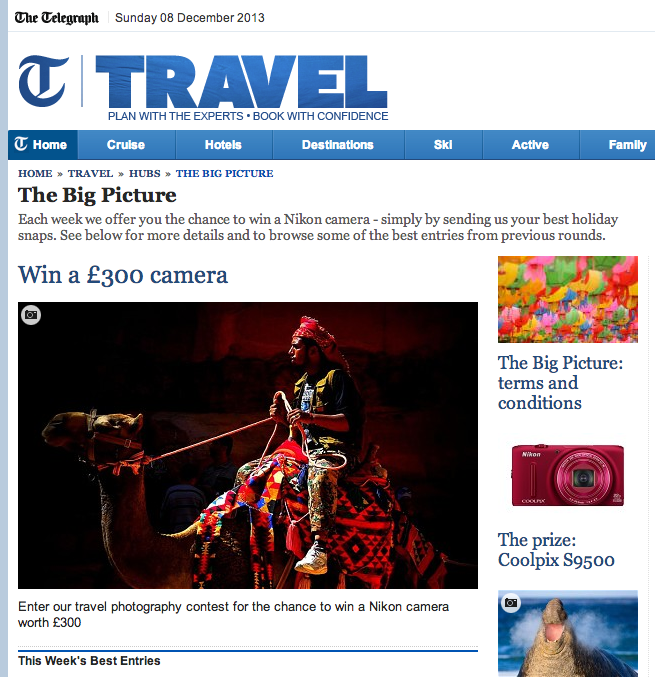
Coming away from the more coveted awards for photography, there are competitions ran by various newspapers, for example, The Telegraph want our best holiday photographs for the chance to win a £300 worth nikon camera. Prizes are not what is relevant in photography competitions, more of a bonus. What I am personally after is recognition, so perhaps this competition will not be the best for this, however would give me the opportunity for my name to get recognised. 


Tuesday, 3 December 2013

Paul Herrmann

Paul Herrmann, a director at Redeye came in too talk to us about career opportunities including the market; pricing, pitching and negotiating with clients; copyright and licensing; access, consent and the law.
Paul Herrmann is a photographer and the director of Redeye, the Photography Network. He has been a freelance editorial photographer since the mid 1980s, specialising in social issues and the arts. In the late 1990s he helped start Redeye, and as its director since 2003 built it to the largest and most successful professional development network for photographers in the UK. 
I have had the pleasure of going to a talk at the Chinese Arts Centre and got the opportunity to listen to Paul Herrmann introduce a photographer there.


When giving the talk in our Universities studio Paul mentioned some really interesting things that I hadn't really started to think about yet. For example, pricing and costs. Being a student still I haven't really put much consideration into payment and pricing up different jobs until Paul mentioned it. He mentioned that It is important if working as a freelance photographer to keep personal and business accounts completely separate and too treat all income from jobs as a business matter therefore getting paid for every aspect of your work.When deciding on a price for allowing a company/publication the use of your image's, you need to consider the media that the photo will be used in; the number of times or the length of time that they want to use the photo; where and in what context the image will be used - size of the print, for example; and whether you are giving the client exclusive use of the image or not. These are all factors that evolve around payment which I have never really thought of before, as I have never sold a piece of work in the past. 
Of course he also mentioned that we should be constantly looking into events that Redeye and other companies produce, as it is a good way of meeting other photographers and allowing for ourselves to get recognised. However, there was one subject that startled me to hear from a lecturer which was photographers not getting paid as much as they should anymore, perhaps I got the wrong gist of the matter but Paul made it seem like we were getting into photography in the wrong era and it was a dying profession (money wise).

Overall the talk was very useful and informative, it was a nice change of pace to hear from someone other than our tutors and too view there opinions and also share our own.


Monday, 2 December 2013

Stock Photography

One of our tasks for this assignment was to think about our PDP objectives and use stock photography to emphasise our objectives. I have personally never done stock photography before, so when coming to photograph my chosen objectives I didn't have much of a clue what to look for within an image. Therefore I started to research into what is considered stock photography and how I would go about using my development objectives, which were: 

  • Enter more competitions, allow for my name to get realised 
  • Contact a wide range of companies with the line of work i'm interested in (War photography)
  • Editing different work, such as videos and photography. Gain more experience with Photoshop and Premiere Pro

"Stock photography is the supply of photographs licensed for specific uses. It is used to fulfill the needs of creative assignments instead of hiring a photographer, often for a lower cost. Today, stock images can be presented in searchable online databases. They can be purchased and delivered online. Often, these photographs involve people, and are produced in studios using a wide variety of models posing as professionals, stereotypes, expressing common emotions and gesticulations, or involving pets. Other common stock photography niches include images related to travel and tourism, as well as conceptual photography" 

- http://en.wikipedia.org/wiki/Stock_photography 

From researching I can see that one of the major stock photography websites are istock by getty images. Which supply a wide range of stock photo's from Animals and pets too technology. What do I gather from stock photography? Stock photography seems to be a low cost, efficient way of getting one's idea across in a simple but effective manor without the use of hiring a photographer. Most websites I have seen cater to a wide variety of different subjects and are basic, yet straight to the point photographs.