One of my key developments I set myself was motivation. Throughout the course I have lacked in motivation, through different factors including myself not really being in the right frame of mind and also the course not meeting the requirements I thought it would have. Although motivation is something I can only control myself it always helps to have something to work for. These past coming assignments have worked wonders for my motivation. Helping the elderly and seeing them become happy as helped me understand that I am making a difference to peoples lives. In turn, this has motivated me to carry on the project and to continue to help people.
Lawrence Giles, our head of photography department also helped me to understand how to stay focused. We sat down and discussed the course in general and how it could be improved etc. Lawrence mentioned that he didn't want me to hold back, that if I felt there was anything wrong with the course I should say so. After the talk I felt relived and my passion that brought me to photography was there again.
I found a website also that helps people to find what to look for when trying to stay motivated: http://www.lifehack.org/articles/productivity/how-to-stay-motivated.html
The website had some very good ideas and through reading it gave me the chance to compare myself to them. Some of the points I am reaching for at the moment.
Tuesday, 13 May 2014

Gathering Contacts
Recently I have been gathering different contacts that may help me when leaving University. These range from wedding photography to photographers numbers. A few people have asked me to photograph there weddings during the length of the course, but I have never been confident enough to undertake it. A wedding is someones special day, far be it for me to ruin it. However, due to my technical skills being up to par and the fact that I will be leaving University very soon I thought it would be a good idea to start collecting numbers of people who want photograph's taking.
Although I am not going to share peoples information over the internet I thought it would be a good idea to discuss these different contacts. I recently met a avid photographer at a local pub, a friend who works in the fashion industry introduced me to him. When talking to the gentleman he asked if I would like to come on a wedding shoot with him, be his assistant if you like. Although I now feel confident enough that I could shoot a wedding on my own, it will be good for me to see how someone else undergo's photographing a wedding.
I have also been asked by a friend of my brother's to photograph there wedding, which the latter paragraph will help me with. One thing I am uncertain of is how much to charge and what equipment I will need to take, therefore I have been asking different photographers and doing some research on the matter.
http://digital-photography-school.com/wedding-photography-21-tips-for-for-amateur-wedding-photographers
The web link above outlined the major do's and don'ts for me and has helped me gather a better understanding of what I need to do when photographing. Below are just a few of the pointers the website gives:
Artist Statement
Basically a statement is a 100-200 word piece of writing which acts as an introduction to your practice as a whole highlighting the common ideas, motivations and process of the work.
- Talk about the physical aspects of the work as well as the conceptual ideas.
- Be objective and clear when talking about the work rather than expressing your personal opinions about it.
- Discuss the medium you work in - does it link to the project concepts in some way?
- Is there a particular intention behind your work? Do you want it to have a particular effect on viewers?
- What social concerns or issues motivate your work?
- Don't include information about past career achievements or other biographical information.
Bulletpoints took from Artquest, which I found through research on google.
Rhys Clarke is a British documentary photographer. His work focuses on the individual and is the voice of the middle man. He wants to create justice and to appeal to those who can make a change. Rhys' work is not just art but a creation of what is happening around him, therefore a story, a story manifested through photography.
Below are some different ideas of what people say in there own personal statements, of which I have been researching and gathering ideas from:


- It is best to write in 3rd person rather than 1st person, so that the statement can be taken without editing for press releases and other materials.
- Don't use unnecessarily technical or complicated terms to describe your work/ideas.- Talk about the physical aspects of the work as well as the conceptual ideas.
- Be objective and clear when talking about the work rather than expressing your personal opinions about it.
- Discuss the medium you work in - does it link to the project concepts in some way?
- Is there a particular intention behind your work? Do you want it to have a particular effect on viewers?
- What social concerns or issues motivate your work?
- Don't include information about past career achievements or other biographical information.
Rhys Clarke is a British documentary photographer. His work focuses on the individual and is the voice of the middle man. He wants to create justice and to appeal to those who can make a change. Rhys' work is not just art but a creation of what is happening around him, therefore a story, a story manifested through photography.
Below are some different ideas of what people say in there own personal statements, of which I have been researching and gathering ideas from:
CV writing
An important part of job searching is having a good CV available at all times with updated information showing the client or employer what you have achieved and been up to before applying for the job. Therefore I have decided to look over my current CV too see what needs changing to make it more suitable for where I am currently standing. Before changing my CV to my requirements I decided to look at some good and bad examples of CV's so I can alter any bad points of my current CV.


The two CV's you see above are very different in many ways. The bad CV have bare minimum information and looks unprofessional and untidy. You can see how the CV's vary from the yellow notes at the side. Taking these notes into consideration I started to look over my own CV to see if anything needed changing. To my disbelieve not much did, other than the fact I have been attending university for the past three years, which I added on. This bit still needs finishing though, but at the moment I do not know what grade I shall receive, if any. Here is my current CV:
Rhys Clarke
33 Moss Lane, Cadishead, M44 5DE
Home: 0161 775 6728 Mobile: 07758209026
Email: rhysc_2k6@hotmail.co.uk
Personal Details
Languages: English Nationality: British Health: Excellent
Profile
I have recently just finished university, I am a enthusiastic and motivated person. As an effective team player I have strong communication skills and I am able to adapt my communication style to the needs of my professional or social environment. I am quick to grasp new ideas and concepts and to develop innovative and creative solutions to problems. I am able to work well on my own initiative and can demonstrate the high levels of motivation required to meet the tightest of deadlines. Even under significant pressure, I possess a strong ability to perform effectively. I have excellent interpersonal skills, accurate organizational ability and an aptitude to pick up new skills to an exceptional standard.
Objective
I am looking to find full time work in a retail environment. I am looking for full time work to support myself financially throughout my studying and also gain good experience in the industry I look to work in, hopefully developing myself further and introducing further employment opportunities.
Education
GCSE’s Subject Grade
English C
Maths C
BTEC Science Pass
Media B
Resistant materials C
ICT B
Geography C
History C
Zenos IT:
CompTIA N+ PASS
CompTIA A+ PASS
Advanced Apprenticeship for IT & Telecoms Professionals PASS
2011-2014 University of Salford BA (Hons) Photography
I studied my GCSE’s at Culcheth High School in Culcheth, Warrington
Culcheth High School
Withington Road
Culcheth
WA3 4JQ
Career Summary
November 2009 - January 2010 Makro
Between November to January I undertook the role as an sales assistant at Makro. This was a temporary role. This role is predominantly customer service however also involves stock replenishments, merchandising, cash handling and security. The role i was undertaking was on the seasonal department.
July 2010 - October 2010 Bank Fashion
Between July to October I undertook the role as an sales assistant at Bank. This was part time work. The role consisted of customer service, stock replenishment, stock taking, security and standards of the store.
June 2008 Carphone Warehouse
I participated of 1 week work experience within Carphone Warehouse. Whilst there, i was involved in the daily running of the department including: programme installing, database work and rearranging of stock. This work placement helped me gain problem solving skills and to improve my communication skills within a team and also as an individual.
September 2010 Zenos
I have recently finished undertaking an IT apprenticeship at Zenos. When at Zenos my main role’s consisted of finishing assignments to there required deadlines, undertaking examinations to gain my CompTIA A+, Microsoft qualifications. This line of work helped me to gain time keeping skills, punctuality and communication skills.
Interests & Activities
I am primarily interested in Fashion, sports and socializing, however I also enjoy music (particularly live), reading and many more activities.
References:
available on request
Contacting Companies - Job Search
When I leave University I am going to need a job in order to support myself and my career path. Therefore I have been searching into jobs that evolve around photography. The jobs I have been looking for do not have to be photographing but something that can bring in an income as well as being around photography. Therefore I have looked at jobs within Canon.

Canon have a wide range of job opportunities including accounting to warehouse worker. All are useful for a student just leaving University. As you can see, under the 'Select job level' category there is an option for Graduate/internship programs.
"Deciding what to do after college or university can be a daunting task, so our Graduate and Internship Programmes are designed to provide you with the experience you need to develop your career in your chosen discipline.
|
Programme
Our Graduate and Internship Programme is currently closed, but register on our careers site and select Graduate or Entry level to receive emails when it reopens"
Sadly the program isn't running at the moment but there is an opportunity for you to register if you wish.
|
Revised PDP
I have recently been thinking about other subjects I am struggling with at the moment. Due to my university life coming to a close very soon I have decided on adding development skills which are mostly based on life after University. Therefore I have revisited my PDP and added a couple more developments I must work on before leaving University. The two developments are: Portfolio and Further Study.
I chose these two developments on the facts that I do not have a very good portfolio at the moment, I have the work to put into it but no real thought has come of making one. Further Study isn't something I intend on doing when I leave university but I thought it would be best to have a plan B.
Here is my revised PDP (Still open to further development):
Photo Competitions
Considering one of my development skills was too enter competitions I went on the search for a site which holds events often. I came across a competition being held by The Guardian. The competition consists of different categories for each month of the year. This month being May, the competition is to photograph 'wild'. On peoples travel's they must photograph what they consider 'wild'.
"Have camera, will travel? Then Guardian Travel's annual photography competition is for you. It's an opportunity for you to capture the essence of your journeys around the world, and for us to showcase your work online and – at the end of the year – in an exhibition at Guardian HQ"

"Have camera, will travel? Then Guardian Travel's annual photography competition is for you. It's an opportunity for you to capture the essence of your journeys around the world, and for us to showcase your work online and – at the end of the year – in an exhibition at Guardian HQ"
Here are the categories for the entire year. Luckily enough 'solitude' is next month, considering I have just done an entire project on that particular category I have decided I will enter a photograph from my final major project. I cannot enter beforehand but I have considered which photograph I will use:
I love the idea of this competition It is my intention to work on the other months. It is not only for the competition, but sites like these allow for your work to be noticed by others which is always a good thing for a photographer.
Portfolio Practice
Considering one of my new PDP targets was to create my own portfolio I decided it would be a good to create a rough digital portfolio on a website called My Carbon Made. My Carbon Made is a free to use portfolio creator, although you do not have access to all the mechanics I would like, it is a quick and easy way to share your work with others. I would not, however, use this site for my final portfolio but it gives me an idea of how a digital portfolio can look and how they present your work. It was interesting to see how your work looks within a portfolio, although I didn't add the entirety of my photographic library, only adding my final major project, it was eye opening to see how it could look.


Above shows how easy the portfolio was to make, a simple add and update scenario. Also shown is how a couple of my images look in the portfolio creator. Although not the most 'pretty' looking portfolio I have seen, it brings across my work well.
Monday, 12 May 2014
The importance of a good Portfolio
A massive part of a photographers arsenal is there portfolio. A portfolio practically sums up the photographers body of work. It is one of the main sources a client will look upon in order to see if they are choosing the right person for the job. The portfolio is the main medium in which to show the work you've created. A true portfolio is a collection of your best works, which are categorised, arranged and presented in an organised manner. I have found a website offering some tips in created a good portfolio:
Know your audience
When making your collection of photos, stop and think about your target audience. Who is going to be looking at these the most? By specifying a certain demographic, you can alter your portfolio to fit their specific interests.
Show only your best
A portfolio is a medium to display your best photos. It shouldn't be a place to vent your emotions, but rather to show off those pictures that are especially well done.
A portfolio is a medium to display your best photos. It shouldn't be a place to vent your emotions, but rather to show off those pictures that are especially well done.
Put them in order
Instead of randomly throwing photos in your portfolio, it's best for your audience if they're in some type of logical order. They can be grouped together by concept, format or even chronologically. It's also best to pay special attention to your first and last photo, as those are most often the most memorable.
Instead of randomly throwing photos in your portfolio, it's best for your audience if they're in some type of logical order. They can be grouped together by concept, format or even chronologically. It's also best to pay special attention to your first and last photo, as those are most often the most memorable.
The first and last pointers of these three key factors of creating a portfolio were something I hadn't thought about in the past when attempting to create my own portfolio. Knowing your audience is a key part in making a client trust your abilities in the types of photography they are looking for. Also putting the work in order never past my mind before. I thought a portfolio was work placed in a folder for people to view and see whether they like it or not.
There are two different types of portfolio: Printed or digital. It is important to have both, but in the ever growing world of the internet a digital portfolio can manage to show the world your work which may lead to new clients which would never of viewed it if it was printed.
Further Study: UAL
I have been considering different opportunities for when I leave university. One that many people talk about is further study. Although further study is not going to be apart of my future I think it i necessary to show and share different opportunities students can undertake. Therefore I have researched into different universities which hold MA Photography courses and there entry requirements. There are many considerations one must think about before attempting to join a further education course, considerations such as accommodation and the tuition fee's. Also what the university acquires from you, things such as a portfolio or perhaps and interview stage.
UAL: University of the Arts London. This London based art school has an MA Photography course which promises:
Here are also some facts which may be relevant for anyone considering applying:
UAL: University of the Arts London. This London based art school has an MA Photography course which promises:
"MA Photography is an international fine art photography course that explores the possibilities of both visual and conceptual expression, merging research deeply with practice. The course is rooted in the idea that photography has no self-limiting identity or essence. In creating work that is visually exciting and intellectually compelling you’ll develop as an artist with photography at the core of your practice, defining, or redefining photography as the art form of 21st Century"
Here are also some facts which may be relevant for anyone considering applying:
| Course Leader |
Dr Daniel Rubinstein
|
|---|---|
| Course Location |
King’s Cross and Archway, London. Tel: +44 (0)20 7514 7023
|
| Study Level | Postgraduate |
| Study Mode | Full time |
| Course Length | PG Cert: full time over 15 weeks Masters: extended full time over 60 weeks |
| Home/EU Fee |
Tuition fees for 2014/15: £3,750 per year. Please note that fees for second year of study will be subject to inflationary increase.
£500 per annum discount for Home/EU students who have completed a PG Dip/Cert or an undergraduate course including Grad Dip/Cert, at UAL.
You can pay course tuition fees in instalments for this course.
|
| International Fee |
Tuition fees for 2014/15: £9,750 per year.
You can pay course tuition fees in instalments for this course.
|
| Start Date | September 2014 |
| Autumn Term Dates | Monday 29 September 2014 – Friday 12 December 2014 |
| Spring Term Dates | Monday 12 January 2015 – Friday 27 March 2015 |
| Summer Term Dates | Tuesday 27 April 2015 – Friday 26 June 2015 |
| Application Route |
Direct application
|
Wednesday, 11 December 2013
Final PDP/Reflection

Overall I am happy with my final chosen developments, they are all subjects on which I struggle with in photography and in day to day life. All are achievable with professionalism and dedication, however it is down to me to be able to carry them on throughout my career and life. This assignment has helped me a lot to discover what help I need to becoming a photographer, it has allowed for me to share my thoughts with fellow students and with the tutors. Most importantly it has give me time to think about what I am lacking and has given me the opportunity to now work on them, to become better at what I do.
Motivation
One of my many weaknesses in photography and through life is motivation. I sometimes struggle to control myself when it comes to work and doing simple things in day to day life. It has recently dawned on me that photography may not be something I want to do after University, this isn't because of my lack of love for the art but because of materialistic things such as money. I understand that money isn't everything in life, but it is sadly a vital part of it. As I keep mentioning different photographers have talked to us about working as a photographer and its disadvantages, which has, to put into words, 'put me off' basing my career around photography. Photography has been and always will be an art that is close to me, as I have been photographing for many years now, Therefore I have decided to take the opportunity given from the assignment to use 'motivation' as one of my developments.
As you can probably tell by now, I aspire to become a documentary/war photographer. To get my mind back on track, I thought it suitable to discuss the photographers that made me want to become a photographer and the people that keep me motivated.
James Nachtwey. James Nachtwey is an American photojournalist and war photographer. Ever since I watched a film about Nachtwey (War Photographer) it has inspired me too want to travel the world and document the misfortunes of others who can not tell their own story. There is a quote that I hold close which says ""I have been a witness, and these pictures are my testimony. The events I have recorded should not be forgotten and must not be repeated." - James Nachtwey. Ever since reading this quote it has encouraged me to use my skills as a photographer to speak for those who can't. As you may be able to tell from my own work, I too photograph dark subject's to create disbelieve and shock to the viewer. This isn't to make the viewers uncomfortable but to show them what is infront of there faces everyday without recognition.
I never really planned on using 'motivation' as one of my final developments, but now I come to think of it, it seems to be a perfect example of a development which I truly need to work on. Maybe it is something I need to overcome on my own, to get in the right frame of mind of what I want to do in the future. One thing is for certain, If I do decided not to carry on my photography career, I will continue photographing for the rest of my life, as it is how I communicate with people, through my images.
Contacting Companies (Continued)
At my current stage as a photographer, although money does sound nice too a person my age, I believe it too be more important as a growing photographer to get recognised. Therefore I have decided to start contacting different charities who are looking for a photographer. Considering my aim is to become a war photographer, Moira insisted that charities is a good place to start. As often enough it is charities who help people abroad in war and poverty stricken areas.
I started too look through the bigger charities that I know of, for example, Oxfam and Unicef. Whilst looking through the Unicef websites I thought it wise to look through the up and coming events that are taking place in the UK. This could be an opportunity to photography the event and get to know some of the workers of Unicef.

David Bull, the Executive Director of UNICEF UK, will be the host for the evening. It is taking place in London, on Monday 9 December 2013 6.30pm-7.45pm at St Paul’s Church. As you can see the event has already taken place and there are no events shown on the website for this year. However, considering we are coming up to the new year very shortly, I am sure there will be other opportunities for me to go to an event and talk to the employee's on Unicef.
Unicef do have photo stories on their websites, I think it would be wise for me to contact the company and let them know my situation as a photographer and would be willing to help photograph an event.

I have found an email which may be useful for me too use for a place of contact. The short paragraphs explain that is any form of media need a story from Unicef then they can receive by using the various contact details. I need too start somewhere, so I think it is best to try and make contact with the company.
Reflections on current PDP
I chose my current three developments because I feel that it is something lacking from my overall performance as a photographer at this moment in time. I chose developments which are suitable for an on-going period of time, meaning I should never really stop, entering competitions/contacting companies for work. We have had a few guest speakers come in over the duration of this assignment and they have all had one thing too say in common, which is, photographers struggling too find work in the current climate. This was quite worrying for a student photographer too hear, therefore I dedicated two of my developments to never stop looking for work, even if that is competitions. This will give me a good frame of mind when leaving University and will hopefully encourage me to continue it upon departure.
My third development (editing) was a skill I rarely use within my own photography as I think it is vital too let people see a photograph how it is taken to provide raw emotion. However, I understand that Photoshop is a massive part of photography now and various employers/companies may be looking for editing skills when offering jobs. Therefore I have tried to accommodate that within my developments, learning Photoshop will hopefully give me an advantage over other possible candidates.
I do believe these are developments which are easily achieved through professionalism and dedication, I hope too maintain these throughout my career as a photography. I believe it too be vital to never stop learning, this is what sets you apart from the others.

Tuesday, 10 December 2013
Layla Sailor & Anna White (Guest Speakers)
Two guest speakers came in recently do discuss there own career and give us a insight into what photography has to offer. Both women often work together on there photo shoots, being close friends for a while they bounce ideas off one another. They both had some really interesting advice to share.
Layla Sailor was born in Manchester, England in 1978, after completing a degree in photography at Manchester in 2005 she has continued to combine commercial fashion photography with fine art & filmmaking. Layla creates hyper-realistic, dreamlike works focusing on colour and styling, she is mainly inspired by russian traditional crafts, religious iconography and politics.


I have completed a Scholarship collaborating with Bolton Museum and University, working with the wider community, creating an archive of work, documenting peoples everyday lives. As well as doing a long term project with elderly LGBT people recording their often hidden lives, as they concealed their true identity when homosexually was illegal. I also carried out workshops with different community groups, including NEETS, young offenders and refugees. In 2006 completed a long term project with the elderly that has been widely exhibited including Tate Britain" - http://www.annawhite.net/about


Layla Sailor was born in Manchester, England in 1978, after completing a degree in photography at Manchester in 2005 she has continued to combine commercial fashion photography with fine art & filmmaking. Layla creates hyper-realistic, dreamlike works focusing on colour and styling, she is mainly inspired by russian traditional crafts, religious iconography and politics.

- http://www.laylasailor.com/272881/home
Anna White "Originally from Suffolk, I’m a freelance photographer and facilitator who studied photography and graduated with a Masters in 2010.
I have completed a Scholarship collaborating with Bolton Museum and University, working with the wider community, creating an archive of work, documenting peoples everyday lives. As well as doing a long term project with elderly LGBT people recording their often hidden lives, as they concealed their true identity when homosexually was illegal. I also carried out workshops with different community groups, including NEETS, young offenders and refugees. In 2006 completed a long term project with the elderly that has been widely exhibited including Tate Britain" - http://www.annawhite.net/about


- http://www.annawhite.net/
After both artists had explained there background and how they came about being a photographer they started to discuss together certain aspects of advice which would help us becoming a photographer. A part of the discussion that stood out for me was Layla explaining how photography work comes about and how often, she explained that sometime's she is left for months without constant work and it always turns out that the work appears all at once. This was rather off putting for a student in photography too hear, but I would rather be told the truth than fed lies.
They both agreed that we should try and branch out from photography, practicing in video might be the edge you need over other contestants of the job. It gives you a wider opportunity for work also.
Another piece of useful advice was too always be prepared too make mistakes whilst on a photo shoot, they explained that something will always go wrong but you have to control your subjects and don't be shy too ask them for a reshoot. This also counts for equipment, they explained that equipment may not always work the way to want it too, so be prepared to learn quickly and be innovative on the job.
I learnt a lot from the talk from both Layla and Anna, It is interesting too hear the truth about my chosen career choice from professionals. I would like to add that I admire both of their work, although both having a massive contrast I can understand fully the concept of there ideas through their images.
Editing
Another one of my personal developments is too understand and learn editing more than I already know. Therefore I started to experiment with different images I have stored on my computer that need editing but have always struggled with doing so. An image I have had for a while was this one:

I fell across this image whilst walking back too Oxford Road train station, there were foreign protesters, protesting against war and rape in Iraq. Although being pleased with this overall photo, I wanted to test myself and try too edit out the boy behind the flag. I am a strong believer of not editing photographs too much, the most I do is change the tones and lighting slightly. However, I thought it best too learn more about photoshop for future reference.
Sadly I didn't print screen my steps, therefore I will try and take you through it step by step, the best I can. The main tool I used is the clone tool, it allows you too select the object next too it and clone it exactly the same, which keep the colouring correct. When you select the tool, hold 'alt' and then select the target, (the brick next too it) and then paint it over the subject piece by piece until your happy that the colouring and brickwork look okay. Then, use the burn tool to add more depth to the colouring to make the lighter patches darker, so it stays nice and contrasted. In this case the brickwork just looks dusty, if it were a colour photo it wouldn't have been as easy. This took my a while to figure out and I used some advice off friends who know the programme better.
Here is the final edited image, granted it isn't the most spectacular editing skills, but it turned out better than expected considering I struggle with Photoshop:

I have been researching into various photoshop classes and tutorials you can pick up from the internet. From researching I came across a website called 'Photoshop Tutorials'. It has many different links too chose from depending on what kind of level of editing skills you are at the current time, they vary from "basics" too "photo manipulation". For an example, I chose the 'Photo Manipulation' which takes you through step by step on how to create a 'chilling abstract'.


There are also various different videos on youtube that show you how to use different effects properly and effectively.

I find this kind of method of learning a lot easier than a written step by step, it allows for you to pause and follow the video so you can edit whilst watching. Here is an example of one of the videos:

I fell across this image whilst walking back too Oxford Road train station, there were foreign protesters, protesting against war and rape in Iraq. Although being pleased with this overall photo, I wanted to test myself and try too edit out the boy behind the flag. I am a strong believer of not editing photographs too much, the most I do is change the tones and lighting slightly. However, I thought it best too learn more about photoshop for future reference.
Sadly I didn't print screen my steps, therefore I will try and take you through it step by step, the best I can. The main tool I used is the clone tool, it allows you too select the object next too it and clone it exactly the same, which keep the colouring correct. When you select the tool, hold 'alt' and then select the target, (the brick next too it) and then paint it over the subject piece by piece until your happy that the colouring and brickwork look okay. Then, use the burn tool to add more depth to the colouring to make the lighter patches darker, so it stays nice and contrasted. In this case the brickwork just looks dusty, if it were a colour photo it wouldn't have been as easy. This took my a while to figure out and I used some advice off friends who know the programme better.
Here is the final edited image, granted it isn't the most spectacular editing skills, but it turned out better than expected considering I struggle with Photoshop:

I have been researching into various photoshop classes and tutorials you can pick up from the internet. From researching I came across a website called 'Photoshop Tutorials'. It has many different links too chose from depending on what kind of level of editing skills you are at the current time, they vary from "basics" too "photo manipulation". For an example, I chose the 'Photo Manipulation' which takes you through step by step on how to create a 'chilling abstract'.
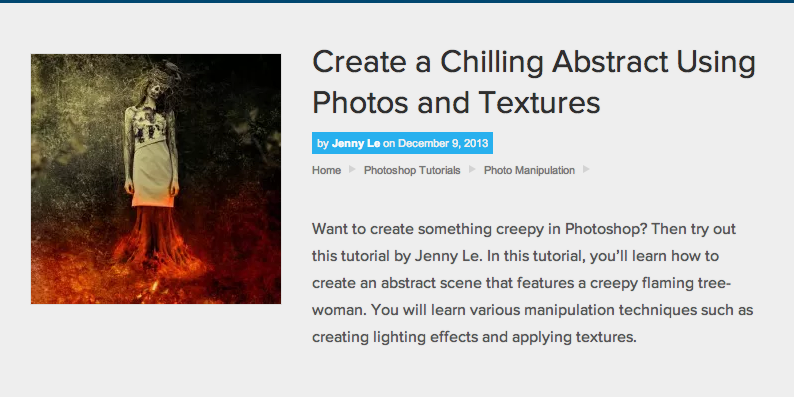
As you can see from the image below, it explains well the direct steps too create such a photograph, its a very useful and appears too be free too use to the general public:

http://www.photoshoptutorials.ws/
There are also various different videos on youtube that show you how to use different effects properly and effectively.

Sunday, 8 December 2013
Contacting Companies
One of my personal developments was to contact different companies which produce work or have work in the same line of subject matter I am interested in. I had the opportunity to speak to Moira about this subject and she gave me some ideas of who I should be contacting, for example, she mentioned the Army, Charities, newspapers and television channels such as Discovery. The profession I want to get into is War photography, hence the before contacts.
Army
My main choice too contact would be the Army, therefore I started to research into whether or not they take on photographers from outside the Army. I researched into the Army website too find this -

This is giving a chance for the public too witness what the Army is like from the soldiers point of view
- "Opening the display at the National Army Museum was Dan Snow, broadcaster and Honorary Colonel of the Army’s Media Operations Group.
He said: “These professional and amateur pictures capture elements of Army life that we just don’t see otherwise, and it’s a reminder that excellence on operations is not only about the frontline, but also about the individual, the bond between soldiers, the training and hard work, and also the lighter side of life. It’s great that the Army this year are able to put these images on display for the public for the first time."
Whether or not photographers can contact the Army and work with them is too be seen, the photograph's on the Army website however appear too be from the soldiers themselves. Perhaps I need to take another route into contacting too gain what I need.
Newspapers
Newspaper journalists and photographers seem too be the most efficient way of getting a job as a "War Photographer". Many of the major newspaper companies cover war stricken areas such as Iraq and recently in Syria. Contacting one of these big companies could be the start I need too photographing war zones. One of the many ways photographers become recognised from newspapers are from being a freelance photographer.
Professional photographers enter countries in war and photograph the events that unfold, then sell there work too newspapers. This is a route I have been contemplating for a long time now, whether I could do it off my own back is yet too be seen. From selling work too newspapers, the newspapers then may give you the opportunity too work for them full-time. This is what I am aiming for with my career.
Subscribe to:
Posts (Atom)